alien & sedition.
Friday, February 02, 2007
See for Yourself
I didn't talk about Kudlow - he introduced Snow with a lengthy diatribe about the all-conquering Milton Friedman and the "total defeat of the left and their statist ideas." It was the first time I've ever been in a crowd that was moved to wild applause by a dis on Keynesianism.

NRO has online video of Newt, Apple Pie Huckabee (I suppose that works out to "Applebee"), and Larry Kudlow speaking at the Conservative Summit. Now you can sit up close and feel the action.
I didn't talk about Kudlow - he introduced Snow with a lengthy diatribe about the all-conquering Milton Friedman and the "total defeat of the left and their statist ideas." It was the first time I've ever been in a crowd that was moved to wild applause by a dis on Keynesianism.
Labels: Conservative Summit, Lawrence Kudlow, Mike Huckabee, Newt Gingrich
¶ Posted by Paul Curtis 9:03 AM 0 comments Thursday, February 01, 2007
Conservative Summit, Part 3: Mr. Huckabee Goes to Washington
I skip the first debate. Saturday was long, and this morning the organizers promise only “continental” breakfast, not the bacon and eggs we got yesterday. I’m not getting out of bed early for a croissant. I believe this is a properly conservative attitude.
Still, it sounded interesting, and I do make it in at the end, just in time to hear Tamar Jacoby insist that Republicans “are digging our grave as a political party by how we talk to immigrants.” Mark Krikorian answers furiously that the GOP is in fact digging its grave by allowing all this immigration – “admitting all these natural Democrats!” He is enthusiastically applauded. Those croissants really got everyone going, I guess.
10:00 am
“From Hope to High Ground” by Gov. Mike Huckabee
Mike Huckabee, though, comes not to bury the conservatives, but to praise them. He has arrived directly from the NBC studio, where he announced for the presidency on Tim Russert’s show. Huckabee is the other Man from Hope. The Man Really from Hope. He jokes that when people ask him what he’ll say about being the second presidential candidate to run from that storied little burg, he answers, “Give us one more chance.”
It’s one more chance than anyone will be giving Crawford, that’s for sure.
He’s handsome in a small-town Jacyee kind of way; he speaks easily, naturally, with an accent that just gets to down-home without tipping on over into redneck. And his name is Huckabee, for Christ’s sake. He’s the human Apple Pie.
We need optimistic conservative leadership, he tells us. “The greatest generation is yet to be born.” This line is so beautifully calibrated to win conservative hearts: the appeal to history and our honored elders (‘the greatest generation’), the Reaganite optimism, and the clear but unstated anti-abortion logic – for how could we kill the greatest generation before they’re even born?
Then comes the up-from-poor-roots story, and he tells us how his father once took him to meet the Governor of Arkansas, and told young Mike to remember this moment, because you’ll probably never meet a governor again. His father passed away only months before Huckabee was sworn in as Governor himself. People are crying. Hell, I’m crying.
“We are not finished as a nation,” he says. And he goes on to talk about the present woes of the conservative movement. This is masterful: he is playing on the right’s need to see its own fortunes and the fortunes of the Republic as one and the same. People rejected the GOP, he says, not because they were rejecting conservatism but because they were frustrated – frustrated “by the greed of Wall Street, the corruption of K Street, and the complete ignoring of Main Street.” Conservatives, he says, win when they do what they’re supposed to do: balance budgets, keep taxes low.
“I’m an optimist,” he says. “The heart and soul of who we are has not been lost – it needs only to be regained.” Again, for ‘we,’ you can read ‘conservatives’ or ‘Americans.’ Brilliant rhetoric.
After some comments on the war, which fall safely within the ‘Iraq=War on Terror’ bamboozlement paradigm (“if the war is lost, our civilization is lost with it”), he turns to domestic matters. He deftly connects the personal to the historical, and then to the political, telling stories of the woes of ordinary Americans.
My God, I realize, he’s feeling our pain.
And he throws the crowd a bit of deliciously red meat: “The flat tax is an idea whose time has come. I think Steve Forbes was right.”
Wild applause. He’s the only speaker at the conference to openly embrace the definitively conservative tax proposal. If he should win the nomination, it’ll be fun to watch as he’s forced to answer for this profoundly regressive idea, but it’s a great shot in the arm for him until then.
Finally he tells us the story of Martha, a school teacher in Little Rock, who took all the desks away from her students one morning and said she wouldn’t give them back until they figured out how they’d earned them. Nobody could come up with the answer, and the story grew throughout the day, until by the afternoon the news media were camped out in the classroom with the puzzled students, and Martha opened the door and in walked 27 veterans, each one carrying a desk, and Martha says this is how you earned them; never forget those who were willing to shed their blood for you. And here Huckabee’s voice cracks a little and a shiver runs down my spine. “We must never forget,” he says. “We must never forget how we got here.”
Standing ovation.
Not once has he mentioned gays or abortion – he doesn’t need to. Where Romney pandered, Huckabee inspires. Later I’ll learn that he has committed his own great sin against conservatism, raising taxes as Governor, and this may be harming him in his presidential ambitions. Still, it’s hard to believe he’s considered nothing more than a dark horse. Keep a wary eye on Mike Huckabee. Conservatism thrives not by the strength of its ideas, but by the strength of its storytelling. That’s why Reagan was the greatest conservative politician of them all. And it’s why Huckabee, the Baptist preacher, seems touched by a little of the Gipper’s magic.
10:30 am
Debate: Resolved: The Federal Government Should Act to Reduce America’s Dependence on Foreign Oil
Jerry Taylor vs. Director James Woolsey
Conservatives are still irritated by President Bush’s reference, in the 2005 State of the Union, to an “addiction to oil.” The reasons seem to run from finding it overly simplistic to just not wanting to talk about it. But now they’re talking about it. And, oddly, it’s the fiercest debate I’ll see at the conference – more contentious even than the one over Iraq.
Woolsey, the former CIA director, is here to make the case that only Federal action can break up America’s strategically disastrous relationship with foreign oil. Taylor, of the Cato Institute, is here to say Woolsey’s full of it.
There is precedent, Woolsey points out, for Federal government involvement in matters of serious national interest: he cites the construction of the trans-continental railway, and the space race. This fits the bill: not only is our economy vulnerable to terrorist attacks on oil infrastructure or regime change in petroleum-exporting countries, we’re paying for the jihad that’s being waged against us. He cites Tom Friedman: “the price of oil and the path of freedom run in opposite directions.” This is a national security matter, and the Federal government must take action.
Taylor’s having none of it. In that particularly smug tone so common to a certain type of libertarian economist (or maybe it’s economists generally), he argues that we import oil because it’s cheaper, which is a good thing, that oil companies factor the cost of terrorist attack into their prices already, that reducing imports doesn’t insulate us from price shocks abroad, that anyway consumers are willing to pay for oil, so what’s the trouble, that only the market can develop viable alternatives to oil if any exist, and that there is no correlation between oil and terror anyway. On this last point, he mentions that he and his economist colleagues ran a regression proving that despite low oil prices in the 90s, terrorism was developing anyway. I laugh to myself. He ran a regression. Well, that solves that.
Woolsey laughs too. “A regression analysis!” he spits. I don’t think I’ve heard three words expressed with such contempt in a long time. All the money supporting terrorists is oil money, he points out. The Saudis are funding wahhabism all over the world with it. The idea that there’s no relationship between oil and terrorism is absurd. Woolsey quotes Orwell: “you’d have to be an economist to believe that. No ordinary person would.”
The debate goes on for a while, fruitlessly. It’s an interesting parallel to the argument over Iraq I saw yesterday. Once again, a former high-ranking national security official, a realist, is banging his head against the wall out of frustration with conservative ideologues. It’s another little window into the ways in which conservatism, which consists of elegant theories about the world, seems to fail when it brushes up against the responsibilities of government. But that’s not stopping these folks.
11:30 am
Presentation: A Conservative Agenda on Domestic Policy
Dr. Charles Kesler, Charles Murray, Ramesh Ponnuru.
Conservatives are funny people. Judging by my experience at the Summit, they’re people who’ll applaud wildly as speakers rail against the “liberal elites,” then turn to each other to discuss their houses in the Hamptons and what a shame it is that “our class” have to pay taxes to subsidize health care for all those poor people, who don’t even pay tax. (I’m serious – I overheard these conversations.) Similarly, they seem to have trouble squaring the circle they create among ideology, self-interest, and the notion that what they do politically maybe ought to actually help people besides themselves. Sometimes they can express the formula quite coherently. Other times it seems to break down under its own complexity.
All weekend they have been insisting that Republicans lost in November because they failed to be properly conservative. All weekend they have dealt with the cognitive dissonance of knowing that, if conservatism is defined by its allegiance to “small government,” then no American government since the Depression has been conservative, and likely no government ever will be. All weekend they have obsessed after their real white whale – not, as Sager says, the Hispanic vote, but rather “small government” itself. They have assumed the American public to be equally dedicated to this pursuit; they have told themselves that when the public abandons them, it’s only because conservatives have let the whale slip too far beyond the horizon.
But only in an incidental fashion have these conservatives considered whether Americans really perceive any benefit from this hunt at all.
Ramesh Ponnuru, NR editor and author of a book that I haven’t read but that I’m going to go ahead and call execrable, stands up and gives a very smart talk. He begins with health care, where he notes that “conservatives have tended to minimize the anxiety people feel about our health system.” 70 million Americans, he observes, are without health insurance at some point in any given year. Besides the human cost, it’s “a serious problem for our economy,” burdening businesses and holding people back from a willingness to seek out new and better jobs. This situation, he points out, is going to lead us to a single-payer health care system if conservatives don’t do something about it first.
Ponnuru criticizes the health care plans proposed by Republican governors Schwarzenegger and Romney. He likes Bush’s proposal, and he likes the old conservative favorite called “Health Savings Accounts” (one day soon I’ll post on this ‘ownership society’ wedge idea). Whatever conservatives propose, he argues, must emphasize the notion of “portability of care” – the assurance that wherever you go, your health coverage will follow.
He’s walking the line, now, between policy as a tool for achieving conservative ideological ends, and policy as a tool for improving people’s lives. He follows that line into a discussion of taxes, making his point clearer as he goes. He argues in favor of a “child tax credit” as an alternative to the politically unrealistic notions of a flat tax or national sales tax. The point is that tax cuts are an area in which conservative policy can have a real, direct benefit on the lives of ordinary Americans. Conservatives, he tells us, cannot politically survive unless they provide policies that directly benefit people. So much of what conservatives propose is said to have the potential for indirectly benefiting ordinary folks, but the public good is never really the main idea.
And here he drops the bomb.
Conservatives are not going to regain power by slashing spending. Look at the electoral results, he says. Conservatives still vote Republican in the same numbers as ever before! “Republicans got slaughtered among independent voters.” For the first time in this conference, somebody is bursting the bubble that says Republicans lost because they weren’t conservative enough. Republicans lost, Ponnuru points out, because Americans don’t believe that conservative ideas benefit them.
But this crucial observation quickly disappears right back into the rhetorical ether. Speaking next, Kesler does ask conservatives to consider what they mean by “limited government.” Do they mean just limiting the growth of government? Actively shrinking it? Or forcibly downsizing it by constitutional means? Kesler criticizes “compassionate conservatism:” compassion, he argues, is not a virtue at all. It can attach to anything, virtuous or not. One can feel compassion for people who do not deserve it. Justice, Kesler says, is the real political virtue. And, by leading people away from “just” understandings of society – who really deserves what – Bush’s ‘compassion’ has constituted a “public abandonment of the conservative principle of limited government," and undermined the fusionism between social and economic conservatism that has sustained the conservative movement.
We are right back in the hunt for the white whale. The real problem, according to Kesler, is the “inevitability of the welfare state.” Perhaps the only way to reverse it might be through ‘constitutional’ methods. What this could mean, we’ll have to find out.
Murray speaks last. He cites the two great conservative electoral victories of the post-war era: the election of Ronald Reagan, and the Gingrich Revolution of 1994. In each case, Murray asserts, voters elected Republicans who explicitly promised to shrink the size of government (Murray’s version of history may be revisionist, but follow the direction of the rhetoric here). Then, in recent years, Republicans “lost their way.” They fell victim to what Hayek called “the fatal conceit:” the notion that social engineering is okay as long as it’s Republicans doing it.
Murray calls for a version of Milton Friedman’s negative income tax, “on steroids.” Go back to Reagan, he says. Go back to the Contract with America. Like Olasky, Murray cites Hurricane Katrina as a lesson that government doesn’t work. “The competence of government,” he says, “is inherently limited.”
Ponnuru’s warning has evaporated. Once again conservatives lash themselves to the mast and pursue their elusive quarry, the maddening objective they call “small government.”
Going unsaid is the lesson most Americans may have learned in the wake of Katrina, Iraq, and every other blunder of the past six years. It’s not that the competence of government is limited. It’s that the competence of conservative government is inherently limited – by conservatives’ own refusal to believe that government can be competent.
And on the conservatives will go without acknowledging this truth, and if they are called to account they will suffer for it in elections, and yet still they’ll pursue their white whale, and they’ll burst their hot hearts’ shells upon it.
12:30 pm
Lunch: Remarks by Tony Snow
Tony Snow is a master at his craft. On the stage, after the chicken course, Snow spins artfully for our entertainment; his lies and distortions and appeals to false principle are every bit as slick as one would expect from the mouthpiece for the most powerful executive in the world. It’s a long way to here from the rough-hewn, down-home mythmaking of Mike Huckabee. But conservatives tell good stories, and there’s every chance that one day the stories Huckabee tells will be just as powdered and polished as those Snow weaves around the Bush administration.
We all know what Snow is going to say. He’s up there to give the Bush line, whatever its hypocrisies, whatever betrayals the conservative idealists in the audience believe it represents. But he does say one interesting thing.
He repeats the famous quote from Bill Buckley, founder of the National Review, who in the magazine’s very first issue defined conservatives as those who were “standing athwart history, yelling ‘Stop!’” Not anymore, says Snow. “Now, we are the agents of history, and we ought to be standing atop it yelling ‘Go!’”
The past quarter century has given us many reasons to believe Snow’s claim. It does seem that in America the conservatives have seized control of our political destiny and shaped it according to their own ends. But history is a funny thing, especially in a democracy. It has a way of evading those who most arrogantly believe that they can change its rules.
It has a way of getting even.
Sunday, January 28
I skip the first debate. Saturday was long, and this morning the organizers promise only “continental” breakfast, not the bacon and eggs we got yesterday. I’m not getting out of bed early for a croissant. I believe this is a properly conservative attitude.
Still, it sounded interesting, and I do make it in at the end, just in time to hear Tamar Jacoby insist that Republicans “are digging our grave as a political party by how we talk to immigrants.” Mark Krikorian answers furiously that the GOP is in fact digging its grave by allowing all this immigration – “admitting all these natural Democrats!” He is enthusiastically applauded. Those croissants really got everyone going, I guess.
10:00 am
“From Hope to High Ground” by Gov. Mike Huckabee
Mike Huckabee, though, comes not to bury the conservatives, but to praise them. He has arrived directly from the NBC studio, where he announced for the presidency on Tim Russert’s show. Huckabee is the other Man from Hope. The Man Really from Hope. He jokes that when people ask him what he’ll say about being the second presidential candidate to run from that storied little burg, he answers, “Give us one more chance.”
It’s one more chance than anyone will be giving Crawford, that’s for sure.
He’s handsome in a small-town Jacyee kind of way; he speaks easily, naturally, with an accent that just gets to down-home without tipping on over into redneck. And his name is Huckabee, for Christ’s sake. He’s the human Apple Pie.
We need optimistic conservative leadership, he tells us. “The greatest generation is yet to be born.” This line is so beautifully calibrated to win conservative hearts: the appeal to history and our honored elders (‘the greatest generation’), the Reaganite optimism, and the clear but unstated anti-abortion logic – for how could we kill the greatest generation before they’re even born?
Then comes the up-from-poor-roots story, and he tells us how his father once took him to meet the Governor of Arkansas, and told young Mike to remember this moment, because you’ll probably never meet a governor again. His father passed away only months before Huckabee was sworn in as Governor himself. People are crying. Hell, I’m crying.
“We are not finished as a nation,” he says. And he goes on to talk about the present woes of the conservative movement. This is masterful: he is playing on the right’s need to see its own fortunes and the fortunes of the Republic as one and the same. People rejected the GOP, he says, not because they were rejecting conservatism but because they were frustrated – frustrated “by the greed of Wall Street, the corruption of K Street, and the complete ignoring of Main Street.” Conservatives, he says, win when they do what they’re supposed to do: balance budgets, keep taxes low.
“I’m an optimist,” he says. “The heart and soul of who we are has not been lost – it needs only to be regained.” Again, for ‘we,’ you can read ‘conservatives’ or ‘Americans.’ Brilliant rhetoric.
After some comments on the war, which fall safely within the ‘Iraq=War on Terror’ bamboozlement paradigm (“if the war is lost, our civilization is lost with it”), he turns to domestic matters. He deftly connects the personal to the historical, and then to the political, telling stories of the woes of ordinary Americans.
My God, I realize, he’s feeling our pain.
And he throws the crowd a bit of deliciously red meat: “The flat tax is an idea whose time has come. I think Steve Forbes was right.”
Wild applause. He’s the only speaker at the conference to openly embrace the definitively conservative tax proposal. If he should win the nomination, it’ll be fun to watch as he’s forced to answer for this profoundly regressive idea, but it’s a great shot in the arm for him until then.
Finally he tells us the story of Martha, a school teacher in Little Rock, who took all the desks away from her students one morning and said she wouldn’t give them back until they figured out how they’d earned them. Nobody could come up with the answer, and the story grew throughout the day, until by the afternoon the news media were camped out in the classroom with the puzzled students, and Martha opened the door and in walked 27 veterans, each one carrying a desk, and Martha says this is how you earned them; never forget those who were willing to shed their blood for you. And here Huckabee’s voice cracks a little and a shiver runs down my spine. “We must never forget,” he says. “We must never forget how we got here.”
Standing ovation.
Not once has he mentioned gays or abortion – he doesn’t need to. Where Romney pandered, Huckabee inspires. Later I’ll learn that he has committed his own great sin against conservatism, raising taxes as Governor, and this may be harming him in his presidential ambitions. Still, it’s hard to believe he’s considered nothing more than a dark horse. Keep a wary eye on Mike Huckabee. Conservatism thrives not by the strength of its ideas, but by the strength of its storytelling. That’s why Reagan was the greatest conservative politician of them all. And it’s why Huckabee, the Baptist preacher, seems touched by a little of the Gipper’s magic.
10:30 am
Debate: Resolved: The Federal Government Should Act to Reduce America’s Dependence on Foreign Oil
Jerry Taylor vs. Director James Woolsey
Conservatives are still irritated by President Bush’s reference, in the 2005 State of the Union, to an “addiction to oil.” The reasons seem to run from finding it overly simplistic to just not wanting to talk about it. But now they’re talking about it. And, oddly, it’s the fiercest debate I’ll see at the conference – more contentious even than the one over Iraq.
Woolsey, the former CIA director, is here to make the case that only Federal action can break up America’s strategically disastrous relationship with foreign oil. Taylor, of the Cato Institute, is here to say Woolsey’s full of it.
There is precedent, Woolsey points out, for Federal government involvement in matters of serious national interest: he cites the construction of the trans-continental railway, and the space race. This fits the bill: not only is our economy vulnerable to terrorist attacks on oil infrastructure or regime change in petroleum-exporting countries, we’re paying for the jihad that’s being waged against us. He cites Tom Friedman: “the price of oil and the path of freedom run in opposite directions.” This is a national security matter, and the Federal government must take action.
Taylor’s having none of it. In that particularly smug tone so common to a certain type of libertarian economist (or maybe it’s economists generally), he argues that we import oil because it’s cheaper, which is a good thing, that oil companies factor the cost of terrorist attack into their prices already, that reducing imports doesn’t insulate us from price shocks abroad, that anyway consumers are willing to pay for oil, so what’s the trouble, that only the market can develop viable alternatives to oil if any exist, and that there is no correlation between oil and terror anyway. On this last point, he mentions that he and his economist colleagues ran a regression proving that despite low oil prices in the 90s, terrorism was developing anyway. I laugh to myself. He ran a regression. Well, that solves that.
Woolsey laughs too. “A regression analysis!” he spits. I don’t think I’ve heard three words expressed with such contempt in a long time. All the money supporting terrorists is oil money, he points out. The Saudis are funding wahhabism all over the world with it. The idea that there’s no relationship between oil and terrorism is absurd. Woolsey quotes Orwell: “you’d have to be an economist to believe that. No ordinary person would.”
The debate goes on for a while, fruitlessly. It’s an interesting parallel to the argument over Iraq I saw yesterday. Once again, a former high-ranking national security official, a realist, is banging his head against the wall out of frustration with conservative ideologues. It’s another little window into the ways in which conservatism, which consists of elegant theories about the world, seems to fail when it brushes up against the responsibilities of government. But that’s not stopping these folks.
11:30 am
Presentation: A Conservative Agenda on Domestic Policy
Dr. Charles Kesler, Charles Murray, Ramesh Ponnuru.
Conservatives are funny people. Judging by my experience at the Summit, they’re people who’ll applaud wildly as speakers rail against the “liberal elites,” then turn to each other to discuss their houses in the Hamptons and what a shame it is that “our class” have to pay taxes to subsidize health care for all those poor people, who don’t even pay tax. (I’m serious – I overheard these conversations.) Similarly, they seem to have trouble squaring the circle they create among ideology, self-interest, and the notion that what they do politically maybe ought to actually help people besides themselves. Sometimes they can express the formula quite coherently. Other times it seems to break down under its own complexity.
All weekend they have been insisting that Republicans lost in November because they failed to be properly conservative. All weekend they have dealt with the cognitive dissonance of knowing that, if conservatism is defined by its allegiance to “small government,” then no American government since the Depression has been conservative, and likely no government ever will be. All weekend they have obsessed after their real white whale – not, as Sager says, the Hispanic vote, but rather “small government” itself. They have assumed the American public to be equally dedicated to this pursuit; they have told themselves that when the public abandons them, it’s only because conservatives have let the whale slip too far beyond the horizon.
But only in an incidental fashion have these conservatives considered whether Americans really perceive any benefit from this hunt at all.
Ramesh Ponnuru, NR editor and author of a book that I haven’t read but that I’m going to go ahead and call execrable, stands up and gives a very smart talk. He begins with health care, where he notes that “conservatives have tended to minimize the anxiety people feel about our health system.” 70 million Americans, he observes, are without health insurance at some point in any given year. Besides the human cost, it’s “a serious problem for our economy,” burdening businesses and holding people back from a willingness to seek out new and better jobs. This situation, he points out, is going to lead us to a single-payer health care system if conservatives don’t do something about it first.
Ponnuru criticizes the health care plans proposed by Republican governors Schwarzenegger and Romney. He likes Bush’s proposal, and he likes the old conservative favorite called “Health Savings Accounts” (one day soon I’ll post on this ‘ownership society’ wedge idea). Whatever conservatives propose, he argues, must emphasize the notion of “portability of care” – the assurance that wherever you go, your health coverage will follow.
He’s walking the line, now, between policy as a tool for achieving conservative ideological ends, and policy as a tool for improving people’s lives. He follows that line into a discussion of taxes, making his point clearer as he goes. He argues in favor of a “child tax credit” as an alternative to the politically unrealistic notions of a flat tax or national sales tax. The point is that tax cuts are an area in which conservative policy can have a real, direct benefit on the lives of ordinary Americans. Conservatives, he tells us, cannot politically survive unless they provide policies that directly benefit people. So much of what conservatives propose is said to have the potential for indirectly benefiting ordinary folks, but the public good is never really the main idea.
And here he drops the bomb.
Conservatives are not going to regain power by slashing spending. Look at the electoral results, he says. Conservatives still vote Republican in the same numbers as ever before! “Republicans got slaughtered among independent voters.” For the first time in this conference, somebody is bursting the bubble that says Republicans lost because they weren’t conservative enough. Republicans lost, Ponnuru points out, because Americans don’t believe that conservative ideas benefit them.
But this crucial observation quickly disappears right back into the rhetorical ether. Speaking next, Kesler does ask conservatives to consider what they mean by “limited government.” Do they mean just limiting the growth of government? Actively shrinking it? Or forcibly downsizing it by constitutional means? Kesler criticizes “compassionate conservatism:” compassion, he argues, is not a virtue at all. It can attach to anything, virtuous or not. One can feel compassion for people who do not deserve it. Justice, Kesler says, is the real political virtue. And, by leading people away from “just” understandings of society – who really deserves what – Bush’s ‘compassion’ has constituted a “public abandonment of the conservative principle of limited government," and undermined the fusionism between social and economic conservatism that has sustained the conservative movement.
We are right back in the hunt for the white whale. The real problem, according to Kesler, is the “inevitability of the welfare state.” Perhaps the only way to reverse it might be through ‘constitutional’ methods. What this could mean, we’ll have to find out.
Murray speaks last. He cites the two great conservative electoral victories of the post-war era: the election of Ronald Reagan, and the Gingrich Revolution of 1994. In each case, Murray asserts, voters elected Republicans who explicitly promised to shrink the size of government (Murray’s version of history may be revisionist, but follow the direction of the rhetoric here). Then, in recent years, Republicans “lost their way.” They fell victim to what Hayek called “the fatal conceit:” the notion that social engineering is okay as long as it’s Republicans doing it.
Murray calls for a version of Milton Friedman’s negative income tax, “on steroids.” Go back to Reagan, he says. Go back to the Contract with America. Like Olasky, Murray cites Hurricane Katrina as a lesson that government doesn’t work. “The competence of government,” he says, “is inherently limited.”
Ponnuru’s warning has evaporated. Once again conservatives lash themselves to the mast and pursue their elusive quarry, the maddening objective they call “small government.”
Going unsaid is the lesson most Americans may have learned in the wake of Katrina, Iraq, and every other blunder of the past six years. It’s not that the competence of government is limited. It’s that the competence of conservative government is inherently limited – by conservatives’ own refusal to believe that government can be competent.
And on the conservatives will go without acknowledging this truth, and if they are called to account they will suffer for it in elections, and yet still they’ll pursue their white whale, and they’ll burst their hot hearts’ shells upon it.
12:30 pm
Lunch: Remarks by Tony Snow
Tony Snow is a master at his craft. On the stage, after the chicken course, Snow spins artfully for our entertainment; his lies and distortions and appeals to false principle are every bit as slick as one would expect from the mouthpiece for the most powerful executive in the world. It’s a long way to here from the rough-hewn, down-home mythmaking of Mike Huckabee. But conservatives tell good stories, and there’s every chance that one day the stories Huckabee tells will be just as powdered and polished as those Snow weaves around the Bush administration.
We all know what Snow is going to say. He’s up there to give the Bush line, whatever its hypocrisies, whatever betrayals the conservative idealists in the audience believe it represents. But he does say one interesting thing.
He repeats the famous quote from Bill Buckley, founder of the National Review, who in the magazine’s very first issue defined conservatives as those who were “standing athwart history, yelling ‘Stop!’” Not anymore, says Snow. “Now, we are the agents of history, and we ought to be standing atop it yelling ‘Go!’”
The past quarter century has given us many reasons to believe Snow’s claim. It does seem that in America the conservatives have seized control of our political destiny and shaped it according to their own ends. But history is a funny thing, especially in a democracy. It has a way of evading those who most arrogantly believe that they can change its rules.
It has a way of getting even.
Labels: Conservative Summit, National review
¶ Posted by Paul Curtis 2:03 PM 8 comments
Notes from the Summit - Ed Whelan on Judges
Whelan is the President of the Ethics and Public Policy Center, and he posts on the "Bench Memos" blog at NRO (he's also a former clerk to Scalia). He spoke in the Saturday afternoon social conservative panel, and I didn't cover his remarks below, but some of it is noteworthy.
First, he aggressively repeats the conservative framing of the judicial fight: "The courts have been the primary aggressors in the judicial wars."
"A major goal here," he says, "has to be to get the courts out of the way." The two main strategies:
Whelan says the two major lessons of the recent judicial wars are:
Liberals really have to do a better job in the framing on this. "Judicial activism" is a poisonous phrase and we've done little or nothing to combat it.
Republicans must insist on up-or-down votes on judicial nominees, Whelan tells us. They only need peel off a few Democratic (or "Independent Democratic") Senators to win floor fights.
Whelan: "It is critical to win in 2008 with a candidate who will make strong judicial appointments." Whoever is elected in '08 could likely have four to six court vacancies to fill.
An audience member asks Whelan to name some good conservative candidates for Supreme Court vacancies. Whelan says "I'm not going to answer that question," but then answers it anyway. Of the top of his head:
The last one, in my notes, looks like "Joey Clemens," but it's hard to read my own writing, and Google turns up nothing. Also tried "Chalmers," but that didn't work either. I suppose it could be Edith Clement or John Cornyn (scroll down), if I'm going deaf or my handwriting has completely gone to pot. Any other ideas?
Part Three of the Summit report will be up this afternoon - getting it ready now. Meanwhile, here's some courts-related stuff I haven't mentioned yet, from Ed Whelan.
Whelan is the President of the Ethics and Public Policy Center, and he posts on the "Bench Memos" blog at NRO (he's also a former clerk to Scalia). He spoke in the Saturday afternoon social conservative panel, and I didn't cover his remarks below, but some of it is noteworthy.
First, he aggressively repeats the conservative framing of the judicial fight: "The courts have been the primary aggressors in the judicial wars."
"A major goal here," he says, "has to be to get the courts out of the way." The two main strategies:
- Winning on judicial appointments
- "Responsible but vigorous criticism" (read: political harassment) of "activist judges."
...
Whelan says the two major lessons of the recent judicial wars are:
- "Quality matters." No more Harriet Miers-es.
- "The public prefers judicial restraint to judicial activism."
Liberals really have to do a better job in the framing on this. "Judicial activism" is a poisonous phrase and we've done little or nothing to combat it.
...
Republicans must insist on up-or-down votes on judicial nominees, Whelan tells us. They only need peel off a few Democratic (or "Independent Democratic") Senators to win floor fights.
...
Whelan: "It is critical to win in 2008 with a candidate who will make strong judicial appointments." Whoever is elected in '08 could likely have four to six court vacancies to fill.
An audience member asks Whelan to name some good conservative candidates for Supreme Court vacancies. Whelan says "I'm not going to answer that question," but then answers it anyway. Of the top of his head:
The last one, in my notes, looks like "Joey Clemens," but it's hard to read my own writing, and Google turns up nothing. Also tried "Chalmers," but that didn't work either. I suppose it could be Edith Clement or John Cornyn (scroll down), if I'm going deaf or my handwriting has completely gone to pot. Any other ideas?
Labels: Bench Memos, Conservative Summit, Ed Whelan, Judicial Nominees, Supreme Court
¶ Posted by Paul Curtis 10:29 AM 0 comments Wednesday, January 31, 2007
Red State on the Summit
I promise that after tomorrow, it won't just be all Summit all the time. But meanwhile, check out msstaley's comment at Daily Kos, pointing out some reactions to the Conservative Summit from RedState. Interestingly, the ones she cites are opinions with which I quite agree.
Labels: Conservative Summit, Daily Kos, Redstate
¶ Posted by Paul Curtis 6:07 PM 0 comments
Notes from the Summit: Reed v. Sager
Reed smugly asserts that "I don't think that affirming marriage is bigotry." He goes on to cite opposition to gay marriage by Bush, Kerry, and Bill Clinton, who all agreed that marriage was 'between a man and a woman.'
"I call that consensus," he says.
Sager destroys him: yeah, he says, but none of them are actually against gay marriage. Nobody seriously believes that Kerry or Clinton oppose it. And even Bush has never done anything about it. Where's the marriage amendment?
Reed looks like a gullible evangelical, getting screwed by the GOP again.
During Q&A, a Hispanic radio host stands up to argue that Republicans can use social conservative hobby horses to bring in Hispanic voters. Sager replies that "the Hispanic vote is the great white whale of the Republican Party."
Reed agrees that, sure, younger voters aren't into banning gay marriage. But "give 'em time." (A woman behind me laughs in agreement: "they're kids.") "You think they don't care about the sanctity of marriage? Wait 'til they get married."
Clearly, Reed is smoking some pretty good stuff.
Sager asks the audience, "what is the conservative movement's answer to the fact that gay people exist?" A murmur of disapproval runs through the room.
They don't have an answer, and they don't want to think about it.
A few more random clips from the Ralph Reed-Ryan Sager debate on Evangelicals and the GOP.
Reed smugly asserts that "I don't think that affirming marriage is bigotry." He goes on to cite opposition to gay marriage by Bush, Kerry, and Bill Clinton, who all agreed that marriage was 'between a man and a woman.'
"I call that consensus," he says.
Sager destroys him: yeah, he says, but none of them are actually against gay marriage. Nobody seriously believes that Kerry or Clinton oppose it. And even Bush has never done anything about it. Where's the marriage amendment?
Reed looks like a gullible evangelical, getting screwed by the GOP again.
...
During Q&A, a Hispanic radio host stands up to argue that Republicans can use social conservative hobby horses to bring in Hispanic voters. Sager replies that "the Hispanic vote is the great white whale of the Republican Party."
...
Reed agrees that, sure, younger voters aren't into banning gay marriage. But "give 'em time." (A woman behind me laughs in agreement: "they're kids.") "You think they don't care about the sanctity of marriage? Wait 'til they get married."
Clearly, Reed is smoking some pretty good stuff.
...
Sager asks the audience, "what is the conservative movement's answer to the fact that gay people exist?" A murmur of disapproval runs through the room.
They don't have an answer, and they don't want to think about it.
Labels: Conservative Summit, gay marriage, Ralph Reed, Ryan Sager
¶ Posted by Paul Curtis 5:34 PM 0 comments
Conservative Summit Part 2: The Interminable Mitt Romney
There’s a bit of cultural whiplash, going from conservative conference to anti-war march and back again, but it’s an interesting mental exercise. Walking west on Pennsylvania Avenue, I shed the outward signs of my real opinions – by Fourth Street, my ‘Out of Iraq’ placard is gone; by Tenth Street I have put the peace button in my pocket. By the time the Marriott heaves into sight I’ve set myself to reassuming a conservative mindset, the kind of outlook that’s less interested in peace, and a lot more interested in wondering how the heck the GOP leadership is going to account for itself after last November’s debacle. Just inside the doors of the Grand Ballroom, a gaggle of dark-suited young conservatives eye my name tag and step aside to let me pass. I gather that they have been assigned to keep any of the anti-war rabble from crashing the conference. And a good thing, too.
1:45 pm
Panel: Editors and the Leaders
Rich Lowry, Kate O’Beirne Q&A w/ Rep. John Boehner, Rep. Eric Cantor
John Boehner is here to offer contrition. The National Review editors are here to publicly flog him – politely and with subtlety, but a flogging nonetheless. They’ll talk policy, but this session is not about substance, it’s about ritual.
They grill him on the Republican failure to pass ethics reform last year (it got hung up in the Senate), about why House Republicans believe they lost, (Iraq, but also because “we lost the confidence of the public to govern”), how the Republican caucus feels about Bush (there’s going to be a problem on immigration), and whether the GOP has a brand problem (yes, “but the brand is an outgrowth of who we are”). Boehner repeats the Grand Truth that has been reiterated ad nauseum at this conference: we must return to our conservative principles. I don’t know whether he really believes this, but he certainly knows what the crowd wants to hear.
The crowd also wants a bit more flogging. One of Boehner’s constituents stands up and asks the Minority Leader whether he has any personal sense of contrition for his own sins against the conservative movement. “And if so, when did you lose your way?” A little thrill runs through the ballroom. A direct hit!
Boehner defends himself half-heartedly: “I don’t feel I ever lost my way.” And he rambles on about earmarks.
The session ends to disgruntled chatter from the audience. “Boehner seemed defensive,” says a man to a woman next to me. “The other speakers talked about what to do next. He seemed entrenched.”
“Grim,” the woman agrees.
2:30 pm
Presentation: A Conservative Agenda on Social Issues
Maggie Gallagher, Professor Robert P. George, Ed Whelan
Moderated by Judge Robert Bork
A chill falls on the room: Bork has arrived. The dark lord of the social conservatives takes the podium to introduce the next panel; he speaks excruciatingly slowly, as though he were demoralizing himself with each word. By the end, my soul hurts.
If you read conservative magazines every week, as I foolishly do, you might notice that it’s mostly all about the money. Social issues tend to seem as though they’re thrown in for filler, for a change of pace. I’m surprised, therefore, to witness how passionately the audience responds to this panel. Judging by the discussion, social conservatives are currently interested in only two little things: life and marriage.
George is a highbrow conservative intellectual: the kind who writes books with titles like Making Men Moral, and In Defense of Natural Law. He argues that government, while it should be limited, must act on the basis of “moral truth:” his truth, of course, not yours or mine. Though now I’m talking like a relativist. George speaks in support of the anti-abortion movement’s “incrementalist” strategy, comparing it to the path taken by the anti-slavery movement all that time ago. He argues that the movement’s next priorities ought to be to 1) “Make high-quality sonography widely available,” and 2) Elect legislators (all over the country) who will “de-fund abortion.” He also speaks about stem-cell research, warning of the dangers of “fetal farming,” and about marriage, arguing that it cannot be a private affair, that government has an interest in “supporting” it.
But the most interesting discussion of marriage comes from Gallagher, the long-time “marriage activist.” For the first time I start to understand how social conservatives see this issue, how they didn’t start talking about marriage in the context of gay marriage, but how they’ve been worried about the institution’s “decline” for quite some time now, and for them gay marriage was just the latest in a long string of battles in what they think is a war to “defend” marriage. “The marriage crisis has nothing to do with gay people,” says Gallagher. She sees gay marriage as an unfortunate diversion – a divisive fight at a time when Americans left and right should be uniting around a defense of marriage.
And then she lays out the deep conceptual dilemma social conservatives face over gay marriage. They can’t just accept it, for a very basic reason:
“How can the marriage movement make the argument that children need mothers and fathers if we accept gay marriage?”
She goes on to explain the really dark fear harbored by anti-gay marriage activists. If the state accepts that there is no difference between gay marriage and other marriage, opposing gay marriage will be treated as racism is treated.
I think that “marriage activists” are deeply confused about the difference between means and ends, fetishizing the one (marriage) for the nominal sake of the other (healthy individuals, healthy society). And I think it’s a disgrace that their social battle lines would hold civil rights hostage to the prejudices and neuroses of various religions. But let’s be clear about the magnitude of the challenge here. Those of us who defend civil rights have argued for a distinction between religious marriage as a private affair and state-sanctioned marriage as a public affair. But for some people, it is impossible to separate those spheres. Not just theoretically, but in everyday practical life.
I don’t believe that Maggie Gallagher hates gay people. I think she is sincere in her belief that marriage needs defending and that gay marriage is a sad battle that must be fought in the course of that defense - because what other option does she have? Perhaps we really do need the work of our religious progressives, because perhaps the battle for justice and equal rights can only be won by recognizing that, spiritually speaking, for very many people, not only is the personal political, but the political is personal.
3:30 pm
Debate: Resolved: President Bush’s Planned ‘Surge’ in Iraq is a Mistake
Lawrence Korb vs. Bill Kristol
Here is the Debate that Dare Not Speak its Name in conservative circles. It’s an open secret that many conservatives – including Bill Buckley, the godfather of NR and all that it spawned – consider the Iraq war a mistake and the ‘surge’ a dumb idea. But it’s still not exactly polite to make a show of it in public. And that, embarrassingly, is what Korb is here to do.
I can feel the hostility in the room before Korb even opens his mouth. He makes great points: we’ve ‘surged’ several times before to no effect; neighboring countries – including Iran – have no interest in a failed state in Iraq, but will only come to the table when we set a date certain for withdrawal, and for the Iraqis themselves, the issue is not how well-trained they are (they’ve had plenty of time to train), but how motivated – and once again, there is no motivation until we provide a deadline. The crowd applauds his opening remarks politely; it’s the last time in the debate anyone will clap for him.
Korb, the realist ex-Reagan official, is up against Dr. Surge himself, the neocon Bill Kristol, who I’m surprised to find is funny and self-deprecating. He jokes – gently – about whether Korb should be “out there demonstrating with Jane Fonda.” And then its on to the wackiness: while the Iraqis might not want us there anymore, “It’s the Iraqis’ country but it’s our war – and I think we should try to win our wars.” Etc., etc.
Korb’s rebuttal is sharp: he wonders why it’s suddenly so in vogue to listen to the generals, considering that the administration had never done that before, and he mocks the notion that Congress’s nonbinding resolution could “send the wrong signal” about American resolve
4:30 pm
Panel: Trumping the Race Card
Ward Connerly, Michael Steele, Dr. Abigail Thernstrom
Thesis: for Republicans, race is not a social issue, it’s an electoral issue. If that seems cynical, it’s hard to avoid. The only references to race I’ve heard at all thus far have to do with strategies for peeling off “the Hispanic Vote,” or a portion of “the Black Vote.” And this panel seems to have been arranged for strategic, not altruistic aims.
Still, that interpretation doesn’t account for the fact that there are black Republicans, some of them here today (though, and I’m saying this purely as an observation, not out of nastiness, this panel is the only point during the conference in which I will see more than one black person in the room. At this panel there as maybe six.). Presumably black Republicans want to talk about blacks and the GOP for reasons that go beyond pure instrumentalism.
Steele speaks first, but reveals very little. He talks about the burden of being an African-American Republican-American, but says nothing much beyond praising “the Party of Lincoln” and asserting that only the GOP can truly provide “empowerment, opportunity, and ownership” for blacks. Connerly tells the story of the Michigan Civil Rights Initiative, the latest in his long line of career-making efforts to end Affirmative Action. He promises a “Super Tuesday for Equality” on November 4, 2008, when he plans to have anti-Affirmative Action referenda on the ballots of 3-5 states at the same time. The states will be “carefully chosen,” but he doesn’t indicate which ones they might be.
Thernstrom, though, reveals something more of the paradox at the heart of conservative attitudes toward race. She bitterly attacks Republicans for voting to uphold the Voting Rights Act, which she blames for creating the majority-black districts that allow the Congressional Black Caucus to, as she sees it, set the tone for African-American politics in the U.S. “Without the spineless groveling of Republicans,” she asserts, “black politics would be very different.” In her interpretation, the GOP, by refusing to force a re-writing of the VRA, has “aided and abetted” a kind of “extremist” racial politics which actually encourages African-Americans to view themselves as alienated from mainstream America. She insists that Republicans must find a distinct “civil rights voice” of their own:
But it does progressives no favors if we ignore the fact that conservatives are talking about it.
After the panel, I wander the various levels of the lobby for a while. In the bar, the still-goateed Jonah Goldberg is shoveling peanuts into his mouth, surrounded by yet another circle of admirers – or is the same circle again and again? The bar is crowded with young Republicans in expensive blue suits. One of them buys Jonah a Miller Lite. “You’re a great American,” he tells Goldberg.
In the main lobby, schools of folks wearing anti-war pins drift through reefs of dark-suited conservatives. Hotel security is refusing entry to a man bearing a protest sign. Near a railing I see a pair of uniformed cops, watching.
7:00 pm
Dinner
Address by Governor Mitt Romney
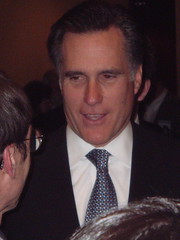
Mitt Romney is no Ronald Reagan. Everyone in the conservative movement seems to be looking for the next Reagan; every politician seeking conservative support is keenly aware of the burden the Gipper’s legacy presents them. And Mitt Romney does not wear it well.
I’ve been sitting at a table near the podium, getting to know my fellow conservatives. Todd, from Albany, introduces himself with a joke: “I work for NARAL.” For a moment I believe him, forgetting where I am. Everyone else laughs heartily, and I join in. When Linda from Colorado sits down, Ian from D.C. steals Todd’s joke. We all laugh again.
Next to me is Brian from Hawaii. He’s quiet and for some reason I begin to suspect that he may be a mole like me. But in deep cover, you never know. Meanwhile, a debate flares up over presidential contenders. Todd likes Giuliani on national security, but doesn’t trust him on the courts. He asks me who I support. I’m a Newt Man, I say – though I’m concerned he may not be electable. I explain that I like the way he talks about politics and the personal. I don’t want to reveal my real reason for supporting him: he’s my friend.
And then, after the main course, Romney takes the stage. He looks, and even sounds, not unlike Martin Sheen doing President Bartlett. But his words. My God, his boring, boring words.
He opens with what seems like a twenty-minute monologue on being a consultant. Somewhere I hear Newt Gingrich spinning in his premature grave.
Then he panders. “I opposed then and do now gay marriage and civil union” (applause). “This is not about adult rights. Gay marriage is about children” (applause). “I’ve changed my views on abortion” (big applause).
He talks about entitlements. He talks about competition from China. It’s like his people have been sitting through each panel at the conference, taking notes and compiling it all into one massive, numbing speech. People are falling asleep at my table. I get up to use the men’s room, and as I slip out, a man whispers to me: “He’s duplicating Bill Clinton at the ’88 convention. Somebody needs to send him a signal.”
Another man, overhearing this, whispers back: “How do you think I feel? I’m from Massachusetts. I’ve heard this all before!”
By the time I get back from the john, Romney has finally finished. He receives a standing ovation, which I think has as much to do with everyone’s need to stretch their legs as anything else.
I’m headed back to my hotel. Mark Steyn has promised us a Night Owl session featuring “Jonah Goldberg in a sparkly Bolero jacket, flouncing around like some queeny waiter in a Malibu restaurant,” but I’m going to have enough psychological baggage from this weekend as it is, without adding that image to my mental catalogue.
And the conservatives aren’t done yet.
Tomorrow: Mr. Huckabee Goes to Washington
Cross-posted at Daily Kos.
There’s a bit of cultural whiplash, going from conservative conference to anti-war march and back again, but it’s an interesting mental exercise. Walking west on Pennsylvania Avenue, I shed the outward signs of my real opinions – by Fourth Street, my ‘Out of Iraq’ placard is gone; by Tenth Street I have put the peace button in my pocket. By the time the Marriott heaves into sight I’ve set myself to reassuming a conservative mindset, the kind of outlook that’s less interested in peace, and a lot more interested in wondering how the heck the GOP leadership is going to account for itself after last November’s debacle. Just inside the doors of the Grand Ballroom, a gaggle of dark-suited young conservatives eye my name tag and step aside to let me pass. I gather that they have been assigned to keep any of the anti-war rabble from crashing the conference. And a good thing, too.
1:45 pm
Panel: Editors and the Leaders
Rich Lowry, Kate O’Beirne Q&A w/ Rep. John Boehner, Rep. Eric Cantor
John Boehner is here to offer contrition. The National Review editors are here to publicly flog him – politely and with subtlety, but a flogging nonetheless. They’ll talk policy, but this session is not about substance, it’s about ritual.
They grill him on the Republican failure to pass ethics reform last year (it got hung up in the Senate), about why House Republicans believe they lost, (Iraq, but also because “we lost the confidence of the public to govern”), how the Republican caucus feels about Bush (there’s going to be a problem on immigration), and whether the GOP has a brand problem (yes, “but the brand is an outgrowth of who we are”). Boehner repeats the Grand Truth that has been reiterated ad nauseum at this conference: we must return to our conservative principles. I don’t know whether he really believes this, but he certainly knows what the crowd wants to hear.
The crowd also wants a bit more flogging. One of Boehner’s constituents stands up and asks the Minority Leader whether he has any personal sense of contrition for his own sins against the conservative movement. “And if so, when did you lose your way?” A little thrill runs through the ballroom. A direct hit!
Boehner defends himself half-heartedly: “I don’t feel I ever lost my way.” And he rambles on about earmarks.
The session ends to disgruntled chatter from the audience. “Boehner seemed defensive,” says a man to a woman next to me. “The other speakers talked about what to do next. He seemed entrenched.”
“Grim,” the woman agrees.
2:30 pm
Presentation: A Conservative Agenda on Social Issues
Maggie Gallagher, Professor Robert P. George, Ed Whelan
Moderated by Judge Robert Bork
A chill falls on the room: Bork has arrived. The dark lord of the social conservatives takes the podium to introduce the next panel; he speaks excruciatingly slowly, as though he were demoralizing himself with each word. By the end, my soul hurts.
If you read conservative magazines every week, as I foolishly do, you might notice that it’s mostly all about the money. Social issues tend to seem as though they’re thrown in for filler, for a change of pace. I’m surprised, therefore, to witness how passionately the audience responds to this panel. Judging by the discussion, social conservatives are currently interested in only two little things: life and marriage.
George is a highbrow conservative intellectual: the kind who writes books with titles like Making Men Moral, and In Defense of Natural Law. He argues that government, while it should be limited, must act on the basis of “moral truth:” his truth, of course, not yours or mine. Though now I’m talking like a relativist. George speaks in support of the anti-abortion movement’s “incrementalist” strategy, comparing it to the path taken by the anti-slavery movement all that time ago. He argues that the movement’s next priorities ought to be to 1) “Make high-quality sonography widely available,” and 2) Elect legislators (all over the country) who will “de-fund abortion.” He also speaks about stem-cell research, warning of the dangers of “fetal farming,” and about marriage, arguing that it cannot be a private affair, that government has an interest in “supporting” it.
But the most interesting discussion of marriage comes from Gallagher, the long-time “marriage activist.” For the first time I start to understand how social conservatives see this issue, how they didn’t start talking about marriage in the context of gay marriage, but how they’ve been worried about the institution’s “decline” for quite some time now, and for them gay marriage was just the latest in a long string of battles in what they think is a war to “defend” marriage. “The marriage crisis has nothing to do with gay people,” says Gallagher. She sees gay marriage as an unfortunate diversion – a divisive fight at a time when Americans left and right should be uniting around a defense of marriage.
And then she lays out the deep conceptual dilemma social conservatives face over gay marriage. They can’t just accept it, for a very basic reason:
“How can the marriage movement make the argument that children need mothers and fathers if we accept gay marriage?”
She goes on to explain the really dark fear harbored by anti-gay marriage activists. If the state accepts that there is no difference between gay marriage and other marriage, opposing gay marriage will be treated as racism is treated.
"And let’s look at what the government does not let racists do:This last one is especially upsetting to social conservatives. For instance, Gallagher says, “the Catholic Church has been forced out of the adoption business in Massachusetts.”
- You can’t run a school
- You can’t have a professional license
- You can’t run a charity."
I think that “marriage activists” are deeply confused about the difference between means and ends, fetishizing the one (marriage) for the nominal sake of the other (healthy individuals, healthy society). And I think it’s a disgrace that their social battle lines would hold civil rights hostage to the prejudices and neuroses of various religions. But let’s be clear about the magnitude of the challenge here. Those of us who defend civil rights have argued for a distinction between religious marriage as a private affair and state-sanctioned marriage as a public affair. But for some people, it is impossible to separate those spheres. Not just theoretically, but in everyday practical life.
I don’t believe that Maggie Gallagher hates gay people. I think she is sincere in her belief that marriage needs defending and that gay marriage is a sad battle that must be fought in the course of that defense - because what other option does she have? Perhaps we really do need the work of our religious progressives, because perhaps the battle for justice and equal rights can only be won by recognizing that, spiritually speaking, for very many people, not only is the personal political, but the political is personal.
3:30 pm
Debate: Resolved: President Bush’s Planned ‘Surge’ in Iraq is a Mistake
Lawrence Korb vs. Bill Kristol
Here is the Debate that Dare Not Speak its Name in conservative circles. It’s an open secret that many conservatives – including Bill Buckley, the godfather of NR and all that it spawned – consider the Iraq war a mistake and the ‘surge’ a dumb idea. But it’s still not exactly polite to make a show of it in public. And that, embarrassingly, is what Korb is here to do.
I can feel the hostility in the room before Korb even opens his mouth. He makes great points: we’ve ‘surged’ several times before to no effect; neighboring countries – including Iran – have no interest in a failed state in Iraq, but will only come to the table when we set a date certain for withdrawal, and for the Iraqis themselves, the issue is not how well-trained they are (they’ve had plenty of time to train), but how motivated – and once again, there is no motivation until we provide a deadline. The crowd applauds his opening remarks politely; it’s the last time in the debate anyone will clap for him.
Korb, the realist ex-Reagan official, is up against Dr. Surge himself, the neocon Bill Kristol, who I’m surprised to find is funny and self-deprecating. He jokes – gently – about whether Korb should be “out there demonstrating with Jane Fonda.” And then its on to the wackiness: while the Iraqis might not want us there anymore, “It’s the Iraqis’ country but it’s our war – and I think we should try to win our wars.” Etc., etc.
Korb’s rebuttal is sharp: he wonders why it’s suddenly so in vogue to listen to the generals, considering that the administration had never done that before, and he mocks the notion that Congress’s nonbinding resolution could “send the wrong signal” about American resolve
.“You say the resolution sends the wrong signal? We had an election. That was the signal.”Kristol will later respond to this remark with a variation on the “we weren’t conservative enough” theme, arguing that much of the anti-war vote was from people who think we’re not fighting hard enough. It carries on, round and round the same circles with which we’re all so familiar. The audience grows increasingly irritated with Korb as the debate continues. I suppose it’s remarkable that this public debate is happening at all within conservative ranks, though the realist/neocon debate is one of the numerous significant fissures within the movement, so perhaps we should expect some airing of opinions. But I’m not left with the impression that anything has been resolved, that the right is any less befuddled by this mess of their own making.
4:30 pm
Panel: Trumping the Race Card
Ward Connerly, Michael Steele, Dr. Abigail Thernstrom
Thesis: for Republicans, race is not a social issue, it’s an electoral issue. If that seems cynical, it’s hard to avoid. The only references to race I’ve heard at all thus far have to do with strategies for peeling off “the Hispanic Vote,” or a portion of “the Black Vote.” And this panel seems to have been arranged for strategic, not altruistic aims.
Still, that interpretation doesn’t account for the fact that there are black Republicans, some of them here today (though, and I’m saying this purely as an observation, not out of nastiness, this panel is the only point during the conference in which I will see more than one black person in the room. At this panel there as maybe six.). Presumably black Republicans want to talk about blacks and the GOP for reasons that go beyond pure instrumentalism.
Steele speaks first, but reveals very little. He talks about the burden of being an African-American Republican-American, but says nothing much beyond praising “the Party of Lincoln” and asserting that only the GOP can truly provide “empowerment, opportunity, and ownership” for blacks. Connerly tells the story of the Michigan Civil Rights Initiative, the latest in his long line of career-making efforts to end Affirmative Action. He promises a “Super Tuesday for Equality” on November 4, 2008, when he plans to have anti-Affirmative Action referenda on the ballots of 3-5 states at the same time. The states will be “carefully chosen,” but he doesn’t indicate which ones they might be.
Thernstrom, though, reveals something more of the paradox at the heart of conservative attitudes toward race. She bitterly attacks Republicans for voting to uphold the Voting Rights Act, which she blames for creating the majority-black districts that allow the Congressional Black Caucus to, as she sees it, set the tone for African-American politics in the U.S. “Without the spineless groveling of Republicans,” she asserts, “black politics would be very different.” In her interpretation, the GOP, by refusing to force a re-writing of the VRA, has “aided and abetted” a kind of “extremist” racial politics which actually encourages African-Americans to view themselves as alienated from mainstream America. She insists that Republicans must find a distinct “civil rights voice” of their own:
“If Republicans want to win elections, it would help to stop pandering to the so-called civil rights movement. … Most Americans know it’s 2007, not 1950s Mississippi.”Setting aside the fact that the past isn’t dead, and it isn’t even past; setting aside the National Review’s own shameful racist history, I’m not sure that everything Thernstrom says can be dismissed as disingenuous. Her CV features writings about race that go beyond crass political hackery, and when she speaks at the conference about the crisis in black education, she’s passionate about it; it matters to her in ways that go beyond electoral calculation. It’s probably a sad commentary on the conservative movement that this should be so noteworthy, and there’s certainly plenty of room to argue that those conservatives who genuinely are interested in racial progress have their prescriptions all wrong.
But it does progressives no favors if we ignore the fact that conservatives are talking about it.
After the panel, I wander the various levels of the lobby for a while. In the bar, the still-goateed Jonah Goldberg is shoveling peanuts into his mouth, surrounded by yet another circle of admirers – or is the same circle again and again? The bar is crowded with young Republicans in expensive blue suits. One of them buys Jonah a Miller Lite. “You’re a great American,” he tells Goldberg.
In the main lobby, schools of folks wearing anti-war pins drift through reefs of dark-suited conservatives. Hotel security is refusing entry to a man bearing a protest sign. Near a railing I see a pair of uniformed cops, watching.
7:00 pm
Dinner
Address by Governor Mitt Romney
Mitt Romney is no Ronald Reagan. Everyone in the conservative movement seems to be looking for the next Reagan; every politician seeking conservative support is keenly aware of the burden the Gipper’s legacy presents them. And Mitt Romney does not wear it well.
I’ve been sitting at a table near the podium, getting to know my fellow conservatives. Todd, from Albany, introduces himself with a joke: “I work for NARAL.” For a moment I believe him, forgetting where I am. Everyone else laughs heartily, and I join in. When Linda from Colorado sits down, Ian from D.C. steals Todd’s joke. We all laugh again.
Next to me is Brian from Hawaii. He’s quiet and for some reason I begin to suspect that he may be a mole like me. But in deep cover, you never know. Meanwhile, a debate flares up over presidential contenders. Todd likes Giuliani on national security, but doesn’t trust him on the courts. He asks me who I support. I’m a Newt Man, I say – though I’m concerned he may not be electable. I explain that I like the way he talks about politics and the personal. I don’t want to reveal my real reason for supporting him: he’s my friend.
And then, after the main course, Romney takes the stage. He looks, and even sounds, not unlike Martin Sheen doing President Bartlett. But his words. My God, his boring, boring words.
He opens with what seems like a twenty-minute monologue on being a consultant. Somewhere I hear Newt Gingrich spinning in his premature grave.
Then he panders. “I opposed then and do now gay marriage and civil union” (applause). “This is not about adult rights. Gay marriage is about children” (applause). “I’ve changed my views on abortion” (big applause).
He talks about entitlements. He talks about competition from China. It’s like his people have been sitting through each panel at the conference, taking notes and compiling it all into one massive, numbing speech. People are falling asleep at my table. I get up to use the men’s room, and as I slip out, a man whispers to me: “He’s duplicating Bill Clinton at the ’88 convention. Somebody needs to send him a signal.”
Another man, overhearing this, whispers back: “How do you think I feel? I’m from Massachusetts. I’ve heard this all before!”
By the time I get back from the john, Romney has finally finished. He receives a standing ovation, which I think has as much to do with everyone’s need to stretch their legs as anything else.
I’m headed back to my hotel. Mark Steyn has promised us a Night Owl session featuring “Jonah Goldberg in a sparkly Bolero jacket, flouncing around like some queeny waiter in a Malibu restaurant,” but I’m going to have enough psychological baggage from this weekend as it is, without adding that image to my mental catalogue.
And the conservatives aren’t done yet.
Tomorrow: Mr. Huckabee Goes to Washington
Labels: Conservative Summit, Mitt Romney, National review
¶ Posted by Paul Curtis 12:33 PM 11 comments Tuesday, January 30, 2007
Notes from the Summit: "The View" on Webb and Hillary
Jim Webb's response to the State of the Union really seems to have gotten under the conservatives' skin. I'll hear denunciations of Webb all weekend, but tonight's panel is impressed. Ingraham thinks Democrats must be “pumped up” about Webb, and she praises him for praising America. She frets that the GOP is losing touch with “the little guy.” We can’t let the Republicans become as elite as we like to say the liberals are, she argues. She even relates a story about a friend's right-wing father who called to ask, "did you hear this Webb guy? I haven't heard a Democrat talk like that in years."
The panelists debate whether Webb represents a genuinely important new development for the Dems. Is our Democrats learning? Charen, who gives me the cold creeps, tries to argue that Republicans shouldn’t worry too much about him. He’s not running for President, and anyway the rest of the Dems are still a bunch of loonies. Ingraham is worried nonetheless. “Heaven forbid if the Democrats became a pro-life party,” she says. “They would be dominant.”
They also discuss the Democratic field: Obama’s a fad, Edwards makes them laugh, but they really fear Hillary. K-Lo asks if HRC will be the next President of the United States. "No," moans the crowd. But it looks stark to the panelists: "Does anyone really think she'll lose any of the states Kerry won?" asks Ingraham.
And the Republicans: Apropos of Mitt Romney, K-Lo asks rhetorically if anyone in the room could vote for someone who voted for Paul Tsongas. Inside my brain, I raise my hand. And Ingraham asks the crowd: “Is everyone in this room looking for the next Reagan?” Big cheers. Make straight the way…
And, of course, they have to get in their digs at Speaker Pelosi. They can't believe she could be a role model. Says Lopez, "I don't think little girls are going to bed tonight dreaming of being Speaker of the House."
Replies Charen: "I hope they're dreaming about Margaret Thatcher."
Part one of the full report will be up in a few minutes (just adding the html). Meanhile, here's an additional snippet from the Friday night panel with Kathryn Lopez, Kate O'Beirne, Mona Charen, Michelle Malkin, and Laura Ingraham.
Jim Webb's response to the State of the Union really seems to have gotten under the conservatives' skin. I'll hear denunciations of Webb all weekend, but tonight's panel is impressed. Ingraham thinks Democrats must be “pumped up” about Webb, and she praises him for praising America. She frets that the GOP is losing touch with “the little guy.” We can’t let the Republicans become as elite as we like to say the liberals are, she argues. She even relates a story about a friend's right-wing father who called to ask, "did you hear this Webb guy? I haven't heard a Democrat talk like that in years."
The panelists debate whether Webb represents a genuinely important new development for the Dems. Is our Democrats learning? Charen, who gives me the cold creeps, tries to argue that Republicans shouldn’t worry too much about him. He’s not running for President, and anyway the rest of the Dems are still a bunch of loonies. Ingraham is worried nonetheless. “Heaven forbid if the Democrats became a pro-life party,” she says. “They would be dominant.”
They also discuss the Democratic field: Obama’s a fad, Edwards makes them laugh, but they really fear Hillary. K-Lo asks if HRC will be the next President of the United States. "No," moans the crowd. But it looks stark to the panelists: "Does anyone really think she'll lose any of the states Kerry won?" asks Ingraham.
And the Republicans: Apropos of Mitt Romney, K-Lo asks rhetorically if anyone in the room could vote for someone who voted for Paul Tsongas. Inside my brain, I raise my hand. And Ingraham asks the crowd: “Is everyone in this room looking for the next Reagan?” Big cheers. Make straight the way…
And, of course, they have to get in their digs at Speaker Pelosi. They can't believe she could be a role model. Says Lopez, "I don't think little girls are going to bed tonight dreaming of being Speaker of the House."
Replies Charen: "I hope they're dreaming about Margaret Thatcher."
Labels: 2008, Conservative Summit, Jim Webb, Kathryn Lopez, Laura Ingraham, Michelle Malkin, Mona Charen, Presidential election
¶ Posted by Paul Curtis 12:13 PM 3 comments